Blog · 2026-10-18
What a squishy sample should prove
One sample, one question. Color, odor, recovery, or the logo — not all of them at once.
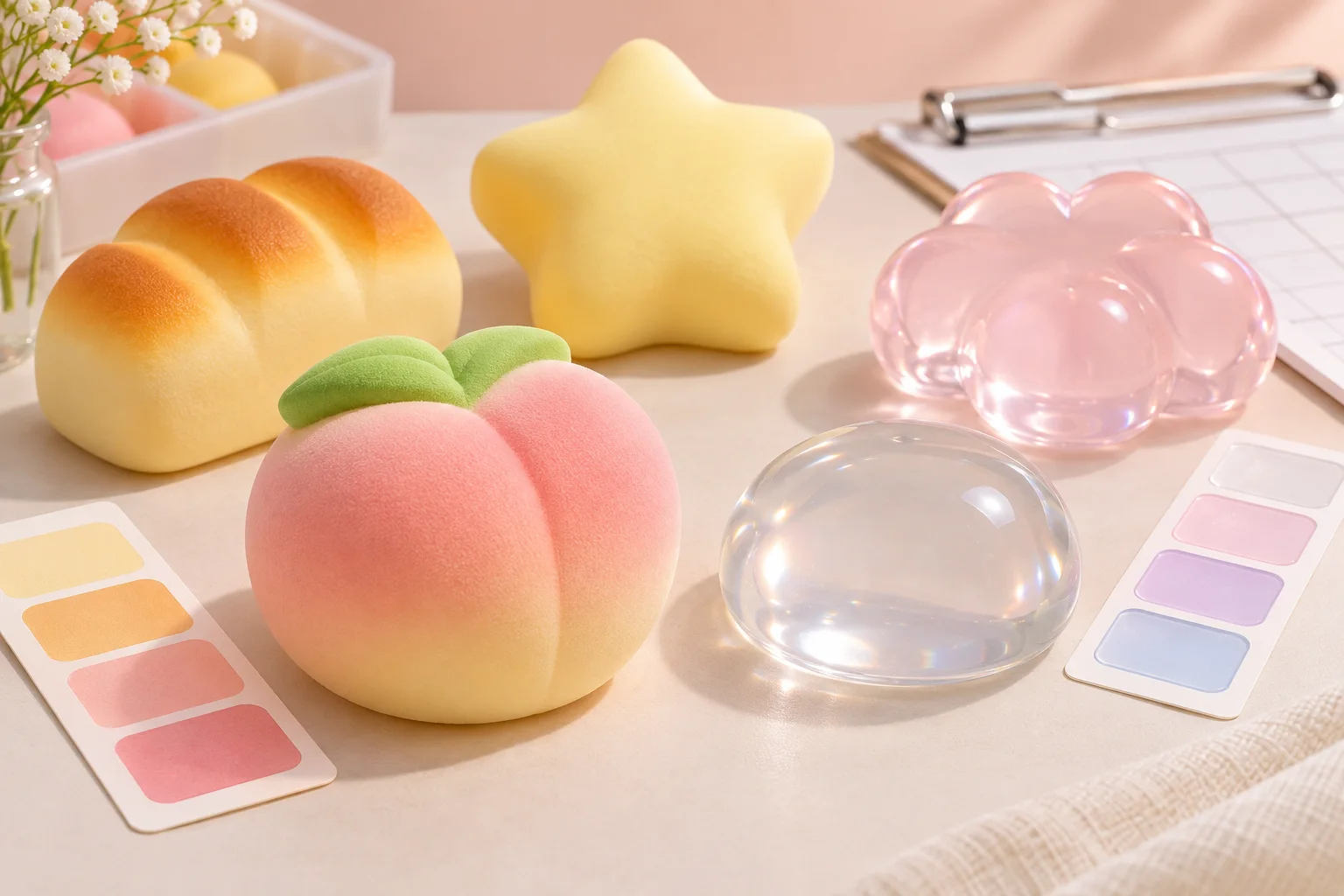
Slow-rise toys fail in ways a photograph cannot. The glitter pools at the bottom. The smell is sweet in a way a shop will not forgive. The piece recovers with a crease. A sample exists to catch that before a deposit does.
The squishy and fidget pages show real items. The capabilities page shows directions. Either can be the start of a sample. Neither photograph is the proof. The proof is the piece in your hand, checked against the question you wrote down.
One question is enough
Ask for the failure you are afraid of. If you sell on camera, ask the sample to be the color you will list, under daylight, next to a ruler you trust. If you sell to schools or to parents, ask how it smells when the bag is first opened, and ask what test plan fits your market. If you are printing a logo, the sample that matters is the decorated one, even if an undecorated piece arrives sooner.
Trying to answer color, odor, recovery, and print on the first piece usually answers none of them well. A first piece in the right material can prove feel. A second piece, if you need it, can prove the logo. Say which one you are buying. The material note, PU, TPR, or silicone, is the companion if you have not chosen yet.
How to check it
Press the piece the way a shopper will, not the way a polite guest will. Watch it recover. Look for a crease that stays, a skin that wrinkles, or a filling that slides to one end and stays there. Bend a thin part. If it whitens or splits, that is the news the sample was for.
Smell it on arrival and again after it has aired. Write down which moment matches the way you will sell it. A piece that only smells acceptable after a week in an open office is not a piece you can poly-bag for retail, unless you are honest about that in the pack, and most brands are not.
Compare the color in daylight and in the light of your shop or your studio. Phone photos shift color. If the listing photo must match, photograph the sample in the same setup you will use for the listing, and send us that photo with your approval or your complaint. A vague 'make it brighter' is hard to hit. A photo is not.
What we will not sample our way around
A reserved shape stays on its own supply line. We will not ask a second workshop to imitate it so the sample is cheaper. A character you do not have rights to will not be sampled at all. If the question is whether a lookalike is close enough, the answer is that we are the wrong desk.
We charge for samples. The courier is separate. On some programs that cost is credited against the first bulk, and the credit is written down or it is not offered. A free sample that answers the wrong question is the expensive kind. The longer sequence, including the golden sample, is in sampling before bulk.
Write the one question into the inquiry. Name the material if you know it. If you do not, name the feel you need, and we will recommend the family to sample.
Keep the sample with the message you send back. If you approve it, say what was approved: material, color, decoration, and pack if the pack came with it. If you reject it, say what failed and what must change. A new shape, a new material, and a new print are three different revisions. Listing all of them as 'please improve' sends the workshop in a circle. One clear failure is a faster path to a piece you can actually sell.
If you approve with a condition, write the condition as a change you can point at. 'Approved if the logo moves onto the card' is usable. 'Approved if it feels more premium' is not. The workshop can move a logo. It cannot interpret a mood. When the revised piece comes back, check only the condition plus anything the revision might have broken. Do not open a new wish list on a piece that already answered the first one.